The Death of Jephthah’s Daughter: A Tragedy of Zeal Without Knowledge

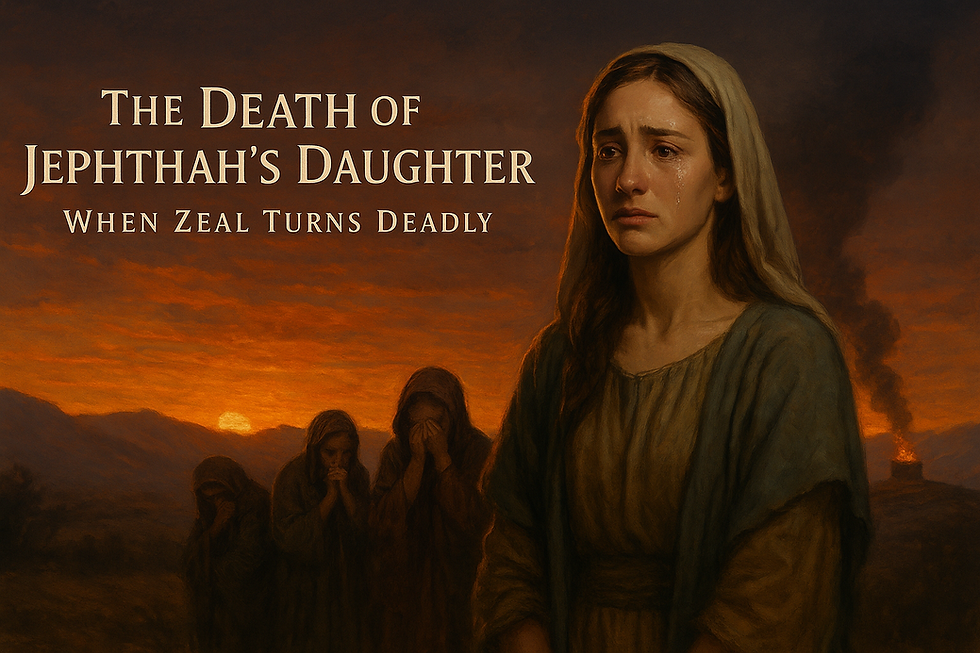
The Death of Jephthah’s Daughter: A Tragedy of Zeal Without Knowledge
This isn’t a story about obedience; it’s about a man whose ignorance of God’s character led him to commit the unthinkable in God’s name. Jephthah’s vow and his daughter’s death expose what happens when faith becomes superstition — when human zeal outruns divine truth.
This article will show from the text itself, language, Strong’s analysis, and historical commentary that Jephthah literally killed his daughter, and that the author of Judges intended it as a mirror of Israel’s moral collapse.
The Hebrew Text — What It Actually Says
Judges 11:30–31 (MT):
“Jephthah made a vow to the Lord and said, ‘If You will indeed hand over the sons of Ammon to me, then whatever comes out of the doors of my house to meet me when I return in peace from the sons of Ammon, it shall be the Lord’s, and I will offer it up as a burnt offering.’”
The key phrase:
וְהַעֲלִיתִיהוּ עֹלָה (vehaʿalîtihû ʿōlāh)— “and I will offer it up as a burnt offering.”
Strong’s Concordance:
H5927 (ʿalah): “to ascend, go up” — the root for offering sacrifices that ascend to God in smoke.
H5930 (ʿōlāh): “burnt offering, wholly consumed offering.”
In every other use of ʿōlāh in Scripture, it refers to a literal sacrifice by fire — never to dedication, celibacy, or service.
Even if the initial “and” (וְ) could be read as “or,” the construction here uses waw-consecutive, linking two verbs of one conditional outcome: “It shall be the Lord’s and I will offer it up.” There’s no grammatical justification for “or.”
The Septuagint (LXX) Confirms the Literal Sense
The Greek translators render:
“καὶ ἀναθήσω αὐτὸ τῷ Κυρίῳ ὡς ὁλοκάρπωσιν.”— “I will dedicate it to the Lord as a whole burnt offering.”
The word ὁλοκάρπωσις (holokarposis) is the origin of our English word holocaust — and it always denotes a literal burnt sacrifice, not symbolic consecration.
The LXX translators, writing centuries closer to the event, clearly understood Jephthah’s intent and actions as literal death by fire.
Context — The Spirit of the Lord and a Pagan Mind
In Judges 11:29, “the Spirit of the Lord came upon Jephthah.” This does not mean divine approval of everything that followed. Throughout Judges, the Spirit empowers deeply flawed men (Samson being the prime example).
Jephthah, raised east of Gilead, lived among tribes heavily influenced by Ammonite and Moabite religion, both of which practiced child sacrifice (see 2 Kings 3:27; Jeremiah 32:35). His theological framework was contaminated.
He knew Yahweh’s name, but not His nature. His vow is a hybrid — a pagan transaction using the language of Israel’s worship.
A Plain Reading of the Text in Context
If we set aside centuries of interpretive discomfort and simply read the story as it stands, the conclusion is unavoidable: Jephthah killed his daughter. Nothing in the Hebrew narrative softens or obscures that outcome.
The sequence is deliberately straightforward:
He makes a vow (Judges 11:30–31).
He wins the battle (vv. 32–33).
He returns home — his daughter comes out to greet him (v. 34).
He grieves the consequence of his vow (vv. 35–36).
She requests time to mourn (vv. 37–38).
She returns, and he does what he vowed (v. 39).
At no point does the narrator interrupt to suggest misunderstanding or substitution. The silence of correction—so loud in Abraham’s story—is itself the judgment.
Verse 39 states explicitly:
“And it came about at the end of two months that she returned to her father, who did to her according to the vow which he had made; and she had no relations with a man.”
This final clause, “and she had no relations with a man,” is often misread as implying a life of celibacy. In context, it’s the opposite—it underscores the tragedy that she died before marriage. The writer memorializes her purity as part of the loss, not the lifestyle.
Verse 40 adds:
“That the daughters of Israel went annually to commemorate the daughter of Jephthah the Gileadite four days in the year.”
The Hebrew verb לְתַנּוֹת (letannot) means “to lament” or “to recount with mourning,” not “to visit” or “celebrate.” The Septuagint preserves this nuance: τοῦ θρηνεῖν—“to weep for.” It was an annual lamentation, not a festival.
A plain reading, therefore, yields this:
Jephthah made a vow of literal sacrifice.
His daughter willingly submitted to it.
Israel memorialized her death with annual mourning.
Nowhere does the text say he didn’t kill her—and if the author meant to suggest that she lived, he could have easily written it. Instead, the story ends with tragedy, because it’s meant to confront readers with the horror of misguided zeal clothed in religious language.
Jephthah’s daughter stands as both victim and prophetess—her fate speaks louder than his faith.
The Silence of Heaven — Judgment by Absence
Notice that unlike Abraham’s sacrifice of Isaac, God never intervenes.
There’s no angelic voice saying, “Do not lay your hand on the child.”
No substitutionary ram, no divine correction.
Only narrative silence.
That silence is not approval — it’s condemnation through absence. The writer of Judges doesn’t need to tell you it’s wrong; the horror is self-evident.
Historical and Rabbinic Witnesses
Ancient Jewish interpreters wrestled with this text, not because it was unclear — but because it was unbearable.
Josephus (Antiquities 5.7.10): “He sacrificed his daughter as a burnt offering, the law forbidding such things notwithstanding.”
Targum Jonathan (Aramaic paraphrase): leaves no ambiguity — the daughter “was offered up.”
Midrash Rabbah, Leviticus 37:4: calls Jephthah’s act “reckless zeal” and blames his lack of Torah knowledge.
Rashi (11th c.) softens it, saying she was dedicated to virginity — but even he admits this is theological discomfort, not linguistic necessity.
Kimchi (12th c.) likewise reinterprets to preserve God’s reputation.
The oldest readings — both Jewish and Christian — took it literally. The symbolic interpretation arose later, out of moral horror, not textual discovery.
Church Fathers and Theological Commentary
Augustine (City of God 5.26): “He slew her whom he should have redeemed; his vow was wicked, his keeping it worse.”
Jerome: “He who made the vow sinned; he who kept it sinned doubly.”
Ambrose: “The Lord would not have his vow kept by murder, for He abhors such offerings.”
Chrysostom: saw it as evidence of how dark Israel’s understanding had become before the monarchy.
No Father justified Jephthah’s act. They condemned it as sin — literal, not metaphorical.
The Daughter’s Mourning — The Narrative Proof
Judges 11:37–39 is devastating in its precision:
“She said to her father, ‘Let this thing be done for me; leave me alone for two months, that I may go to the mountains and weep because of my virginity, I and my friends.’”
“And at the end of two months she returned to her father, who did to her according to the vow which he had made; and she had no relations with a man.”
Her mourning of virginity is not symbolic of a monastic life — it’s lamenting that she would die before bearing children. The phrase “he did to her according to his vow” seals it.
The Septuagint again removes all ambiguity: “καὶ ἐποίησεν αὐτῇ τὸν εὐχόμενον εὐχὴν.” — “He performed on her the vow he had vowed.”
Had she merely remained unmarried, it would not require the specific statement that she returned and then he “did” the vow.
Theological Meaning — A Nation Like the Nations
Jephthah’s sacrifice is not an isolated tragedy; it’s theological diagnosis. Israel, called to be distinct, has become indistinguishable from her neighbors. The man empowered by God kills his own child to please Him — just as pagans did to Molech.
This is the point. The story is meant to make the reader sick. It’s an x-ray of a nation that knows Yahweh’s name but not His heart.
The refrain of Judges — “In those days there was no king in Israel; everyone did what was right in his own eyes” — echoes here louder than anywhere else.
Christ Connection — The Father and the Only Child
Jephthah’s story casts a grim shadow that only Christ can redeem. Both involve a father and an only child. Both end in sacrifice — but with opposite motives and outcomes.
Jephthah offers his daughter to manipulate God.
The Father offers His Son to save humanity.
Jephthah’s sacrifice reveals false religion: man’s attempt to buy divine favor.
The cross reveals true faith: God’s free gift of grace to the undeserving.
Where Jephthah’s daughter dies because of her father’s foolishness, the Son dies because of the Father’s faithfulness.
Christ-Centered Conclusion
The story of Jephthah’s daughter is not a puzzle to sanitize — it’s a mirror to recognize. It shows what religion becomes when people stop listening to the Word of God and start mixing truth with superstition.
God did not desire this vow, command it, or condone it. But He recorded it — so His people would never forget what happens when zeal is unrestrained by knowledge.
“For I desire mercy, not sacrifice, and the knowledge of God rather than burnt offerings.” (Hosea 6:6, NASB)
Scripture quotations taken from the New American Standard Bible® (NASB), Copyright © 1960–2020 by The Lockman Foundation. Used by permission. All rights reserved.


