Jephthah and the Danger of Rash Vows


Jephthah and the Danger of Rash Vows
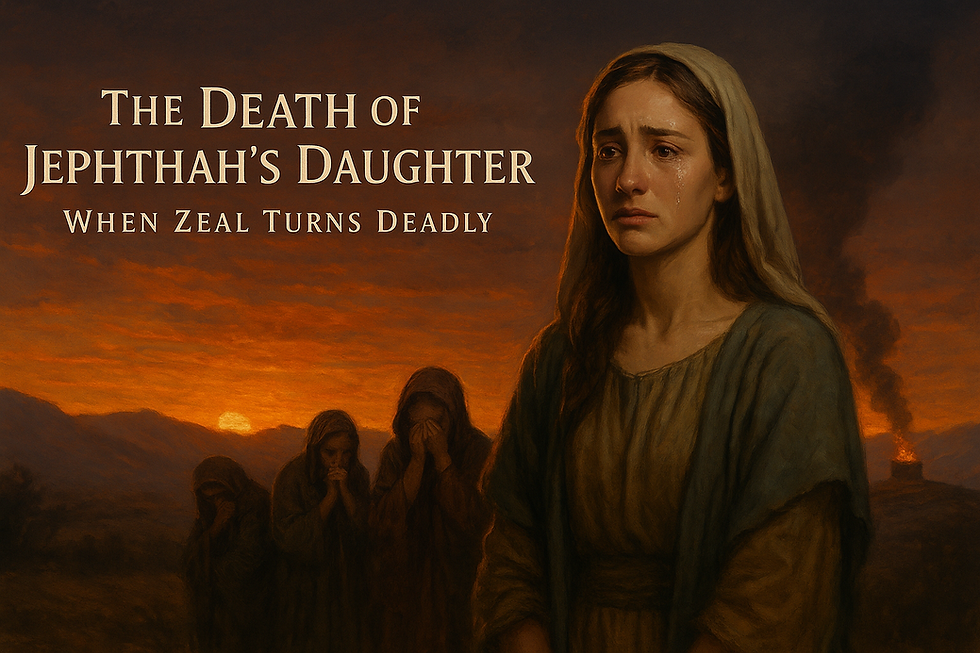
Jephthah’s story is one of tragedy born from zeal without wisdom. His rise from outcast to leader, his military victory, and his infamous vow to sacrifice “whatever comes out of the doors of my house” (Judges 11:31) all reveal a sobering truth: passion without understanding can destroy what God intended to bless.
It’s not a story about God demanding sacrifice—it’s a warning about humanity’s attempt to manipulate divine favor. Jephthah’s words remind us how easily fervor turns fatal when our mouths run ahead of our theology.
Biblical Foundation
“Jephthah made a vow to the Lord and said, ‘If You will indeed hand over the sons of Ammon to me, then whatever comes out of the doors of my house to meet me when I return in peace from the sons of Ammon, it shall be the Lord’s, and I will offer it up as a burnt offering.’” (Judges 11:30–31, NASB)
“When Jephthah came to his house at Mizpah, behold, his daughter was coming out to meet him with tambourines and with dancing; and she was his one and only child; he had no other son or daughter.” (Judges 11:34, NASB)
The Hebrew text highlights the shocking ambiguity in Jephthah’s vow. The phrase “whatever comes out” uses the masculine relative pronoun asher (אֲשֶׁר), which could mean whoever or whatever. It leaves room for both human and animal interpretation—a deliberate narrative tension showing the danger of careless speech.
In the Septuagint (LXX), Jephthah’s vow is rendered: “ἐὰν ὄντως παραδῷς... τὸ ἐξερχόμενον ἀπὸ τῶν θυρῶν τοῦ οἴκου μου... ἀναθήσω αὐτὸ εἰς ὁλοκάρπωσιν.” The term ἀναθήσω (from anatithēmi) means “I will dedicate,” while ὁλοκάρπωσιν translates “whole burnt offering.” The LXX captures both meanings—dedication or sacrifice—reflecting the moral and linguistic tension of the text.
Historical & Contextual Notes
Jephthah’s background is one of rejection and redemption. Born the son of a prostitute, he is cast out by his half-brothers (Judges 11:1–2). Yet, when Israel is oppressed by Ammon, the same men beg him to return and lead them.
His leadership begins well—he negotiates diplomatically (Judges 11:12–27), citing history and appealing to justice. But his vow reveals a Canaanite influence in his thinking. Pagan cultures often tried to secure divine favor through extreme offerings. Jephthah’s words echo their superstition, not covenant faith.
The Spirit of the Lord had already come upon him (Judges 11:29); his victory was guaranteed. His vow wasn’t devotion—it was doubt disguised as religion.
Misconceptions / Objections
“Jephthah didn’t really sacrifice his daughter; she just remained unmarried.”
This view, though merciful, doesn’t align clearly with the Hebrew or the context. The phrase “offered her up as a burnt offering” (wayya‘alēhā ‘ōlāh) is consistent with literal sacrifice elsewhere in Scripture. The horror is intentional—it confronts the reader with the cost of reckless zeal. The LXX likewise preserves the starkness: “ἀνέβη αὐτὴν ὁλοκαύτωμα”—“he offered her as a whole burnt offering.” The tragedy stands not to endorse, but to condemn.
“God accepted the vow.”
No—God never sanctioned it. The silence of heaven in this passage is judgment enough. This was not obedience but blasphemy; Jephthah used the language of worship to commit an abomination.
“Jephthah’s vow proved his devotion.”
True devotion submits to God’s will, not manipulates it. His zeal lacked knowledge—a theme Paul echoes centuries later: “For I testify about them that they have a zeal for God, but not in accordance with knowledge.” (Romans 10:2).
Theological Reflection
Jephthah’s story reveals how religious language can mask unbelief. His words, meant to secure God’s favor, become a covenant of death. It’s not just a personal tragedy; it’s theological commentary on Israel’s spiritual decay.
Israel, like Jephthah, had mixed true faith with pagan superstition. The vow symbolizes the nation’s syncretism—a blend of Yahweh worship and Canaanite ritual. God’s Spirit empowered Jephthah for deliverance, but the Spirit does not override free will. Divine power does not sanctify human foolishness.
The Hebrew word for vow, neder (נֶדֶר), comes from a root meaning “to bind.” Jephthah’s binding of himself leads to bondage. The LXX uses εὔξατο εὐχήν—“he vowed a vow”—the same phrasing used positively for Hannah’s vow (1 Samuel 1:11). But where Hannah’s vow brings life, Jephthah’s brings death. It’s a deliberate inversion—a theological mirror showing how the same act, when misdirected, becomes sin.
Connection to Christ
Jephthah’s story finds its redemption not in his vow but in its reversal through Christ. Where Jephthah’s rash promise costs the life of his innocent child, the Father’s deliberate promise brings life through the sacrifice of His Son.
Both accounts center on an only child, but the contrast is the Gospel itself:
Jephthah sacrifices to gain favor; God sacrifices to give grace.
Jephthah’s vow springs from insecurity; God’s covenant springs from love.
Jephthah’s daughter dies unwillingly; Christ dies willingly.
Even the language of burnt offering (‘ōlāh, ὁλοκάρπωσιν) finds fulfillment in Christ’s complete surrender—“an offering and a sacrifice to God as a fragrant aroma.” (Ephesians 5:2).
Christ-Centered Conclusion
Jephthah’s life reminds us that zeal must be anchored in truth. Passion for God, apart from understanding His Word, leads to destruction. The lesson isn’t to fear vows but to fear presumption—to stop bargaining with the God who has already given everything.
Faith doesn’t say, “If You will…” Faith says, “Because You have…”
“Guard your steps as you go to the house of God and draw near to listen rather than to offer the sacrifice of fools.” (Ecclesiastes 5:1, NASB)
Jephthah’s story ends in silence, but the Gospel speaks louder: the only sacrifice God desires is a broken and contrite heart. (Psalm 51:17).
Scripture quotations taken from the New American Standard Bible® (NASB), Copyright © 1960–2020 by The Lockman Foundation. Used by permission. All rights reserved.