The Burning Bush: God’s Holy Ground and the Call of Moses

Updated: Sep 12, 2025
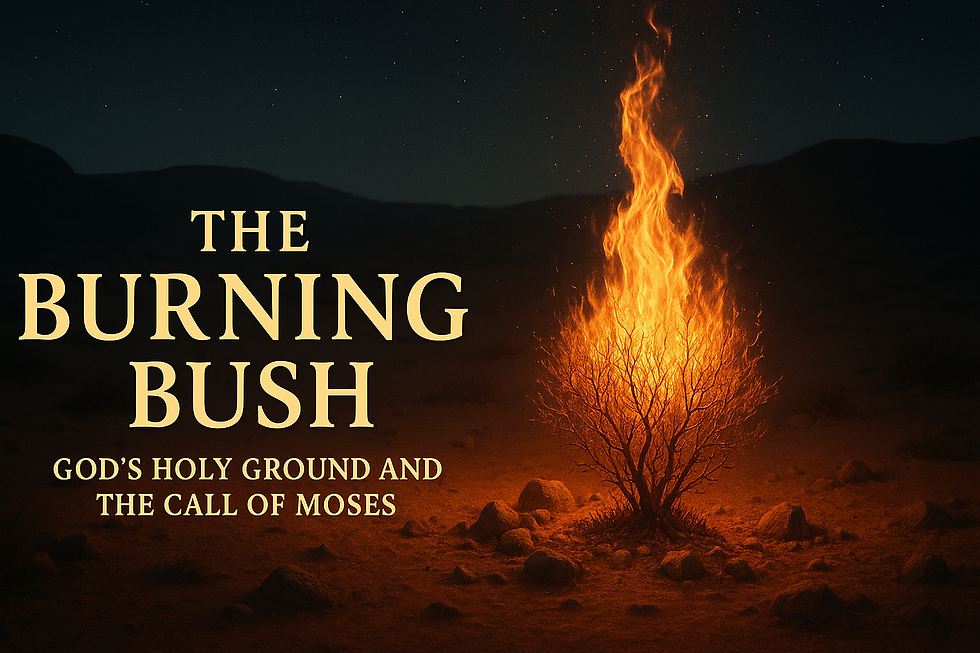
The Burning Bush: God’s Holy Ground and the Call of Moses
A shepherd in the wilderness, an unquenchable flame, and a voice from heaven—Exodus 3 presents one of the most defining moments in salvation history. The burning bush is more than a dramatic call; it reveals God’s holiness, His covenant name, and His plan to redeem His people. For every believer, it’s a reminder that God still calls ordinary people to extraordinary obedience.
Biblical Foundation
“Now Moses was pasturing the flock of his father-in-law Jethro, the priest of Midian; and he led the flock to the west side of the wilderness and came to Horeb, the mountain of God. Then the angel of the Lord appeared to him in a blazing fire from the midst of a bush; and he looked, and behold, the bush was burning with fire, yet the bush was not consumed.” (Exodus 3:1-2)
God calls from the flame: “Do not come near here; remove your sandals from your feet, for the place on which you are standing is holy ground” (v.5). The Hebrew for holy, קָדוֹשׁ (qadosh), means set apart, utterly unique. God identifies Himself: “I am the God of your father—the God of Abraham, the God of Isaac, and the God of Jacob” (v.6).
The dialogue crescendos with God’s self-revelation: “I AM WHO I AM” (Exodus 3:14). The Hebrew אֶהְיֶה אֲשֶׁר אֶהְיֶה (Ehyeh Asher Ehyeh) literally means “I will be who I will be,” capturing God’s eternal, self-existent nature.
Historical & Contextual Notes
The Angel of the Lord: Early Jewish and Christian interpreters often identify the “angel of the Lord” (Hebrew מַלְאַךְ יְהוָה, mal’akh YHWH) as more than a created messenger—many Church Fathers saw a pre-incarnate appearance of Christ.
Fire Without Consumption: Fire often symbolizes God’s presence and purity (cf. Hebrews 12:29). The bush’s unconsumed state speaks of God’s sustaining power and Israel’s preservation in affliction.
Mount Horeb/Sinai: The mountain where Moses meets God will later host the giving of the Law and the covenant. God meets His people where He plans to bind them to Himself.
Misconceptions & Objections
A Natural Phenomenon? Some argue the bush was simply a desert plant glowing at sunrise. The text, however, presents a miracle: a bush that burned continuously without being consumed, accompanied by a divine voice.
Moses’ Reluctance Equals Disobedience? Moses’ hesitation (3:11; 4:10) shows humility and fear, but not hardened rebellion. God graciously equips him with signs and Aaron as spokesman.
Theological Reflection
The burning bush discloses profound truths:
God’s Holiness demands reverence. Removing sandals is more than ritual—it symbolizes leaving behind impurity and control.
God’s Self-Existence is central. His name I AM shows He depends on nothing, yet chooses to dwell with His people.
God’s Mission is redemptive. He reveals Himself not for spectacle but to rescue Israel and point forward to ultimate redemption in Christ.
In Greek (Septuagint), I AM is rendered ἐγώ εἰμι ὁ ὤν (egō eimi ho ōn), “I am the One who is,” which Jesus echoes in John 8:58: “Before Abraham was born, I am.”
Connection to Christ – The Great “I AM”
When God declared His name to Moses—“I AM WHO I AM” (Exodus 3:14)—He revealed Himself as eternal, self-existent, and unchanging. Centuries later, Jesus of Nazareth took that very name upon Himself.
John 8:58 – “Truly, truly, I say to you, before Abraham was born, I am.”
His audience recognized the claim and tried to stone Him for blasphemy.
John 6:35 – “I am the bread of life; the one who comes to Me will not be hungry.”
John 8:12 – “I am the Light of the world; the one who follows Me will not walk in the darkness.”
John 10:11 – “I am the good shepherd; the good shepherd lays down His life for the sheep.”
John 11:25 – “I am the resurrection and the life; the one who believes in Me will live, even if he dies.”
John 14:6 – “I am the way, and the truth, and the life; no one comes to the Father except through Me.”
John 15:5 – “I am the vine, you are the branches; the one who remains in Me, and I in him bears much fruit.”
Each saying begins with the Greek ἐγώ εἰμι (egō eimi), the same wording used in the Greek Septuagint of Exodus 3:14 (egō eimi ho ōn).By speaking this way, Jesus was not merely teaching metaphorically—He was claiming to be the very covenant God who met Moses in the flames.
The burning bush therefore becomes a living preview of the incarnation: the eternal “I AM” stepping into human history, first in a fiery shrub, ultimately in flesh and blood.
Christ-Centered Conclusion
The burning bush foreshadows the incarnation. Just as the bush blazed without being consumed, Christ bears divine glory in human flesh without being destroyed. The God who calls from fire now calls through His Son, inviting us to holy ground by His Spirit.
The lesson endures: God’s presence transforms ordinary places and people into holy instruments for His saving mission.
All Scripture quotations are from the New American Standard Bible (NASB), © The Lockman Foundation. Used by permission. All rights reserved.


