Aaron’s Ordination and the Consecration of Priests: Holiness in Blood and Oil

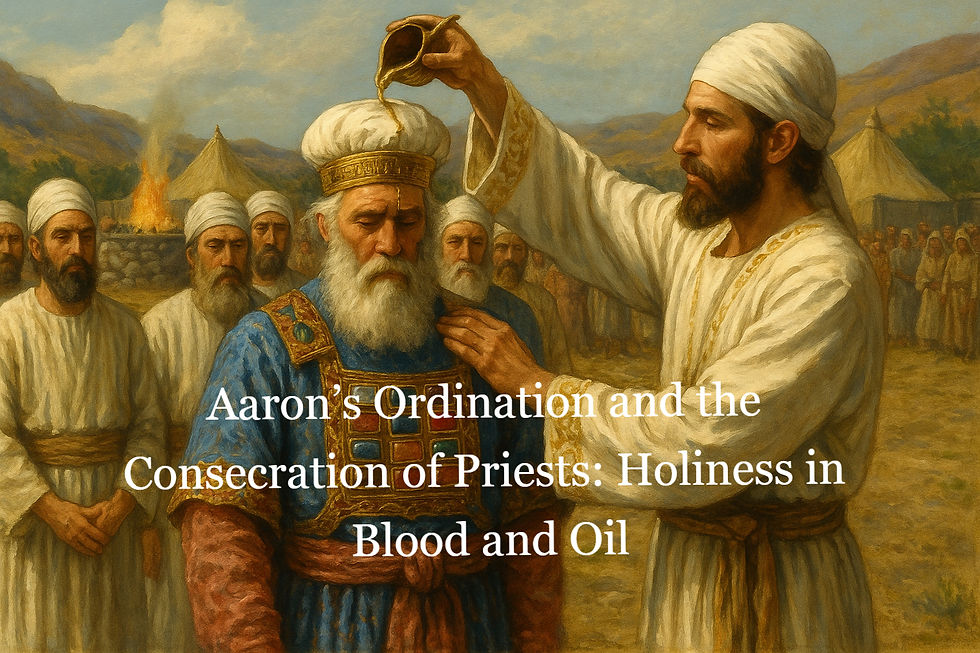
Aaron’s Ordination and the Consecration of Priests: Holiness in Blood and Oil
God’s presence in the tabernacle required more than beautiful design; it demanded holy ministers. Exodus 28–29 and Leviticus 8–9 describe how Aaron and his sons were set apart as priests. Their ordination reveals how sinful people can stand before a holy God—and how Jesus fulfills and surpasses that priesthood.
Biblical Foundation
“Then bring near to yourself Aaron your brother, and his sons with him, from among the sons of Israel, to serve as priests to Me—Aaron, Nadab and Abihu, Eleazar and Ithamar, Aaron’s sons.” (Exodus 28:1, NASB)
God gave detailed instructions for garments, sacrifices, and anointing:
“Then you shall take the anointing oil and pour it on his head and anoint him.” (Exodus 29:7, NASB)
“So Moses slaughtered it and took some of its blood and put it on the lobe of Aaron’s right ear, on the thumb of his right hand, and on the big toe of his right foot.” (Leviticus 8:23, NASB)
This threefold application signified that hearing, doing, and walking must all be consecrated to God.
Historical & Contextual Notes
Priestly Garments: The ephod, breastpiece with twelve stones, and turban reading “Holy to the Lord” (Exodus 28:36, NASB) displayed the priest as a representative of the whole nation.
Blood and Oil Together: Blood symbolizes atonement; oil represents the Spirit’s empowerment. Holiness requires both cleansing and indwelling presence.
Seven-Day Ordination: A week-long ceremony mirrored creation, showing that priestly service was part of God’s new creation plan.
Misconceptions & Objections
“This was just empty ritual.”
Every step foreshadowed Christ’s saving work and the Spirit’s consecration.
“Ordination makes someone sinless.”
Aaron still sinned (e.g., the golden calf). The rituals pointed to a better High Priest.
Theological Reflection
The priesthood shows that access to God requires both sacrifice and Spirit. Cleansing blood deals with sin; holy oil empowers service. The Hebrew term מָשַׁח (mashach, to anoint) gives us the word Messiah—the Anointed One.
Connection to Christ – Our Great High Priest
Aaron’s ordination finds fulfillment in Jesus:
Perfect Sacrifice and Priest: “We have such a high priest, who has taken His seat at the right hand of the throne of the Majesty in the heavens.” (Hebrews 8:1, NASB)
Anointed by the Spirit: At His baptism, “the Holy Spirit descended upon Him in bodily form like a dove” (Luke 3:22, NASB).
Cleansing and Sending His People: Believers are now called “a royal priesthood” (1 Peter 2:9, NASB), set apart by His blood and filled with His Spirit.
Jesus is both the sacrifice that purifies and the High Priest who continually intercedes for His church.
Christ-Centered Conclusion
Aaron’s consecration reveals the heart of worship: forgiven and Spirit-filled people serving a holy God. In Christ we find the reality to which the blood and oil pointed—perfect cleansing and eternal access to the Father.
All Scripture quotations are from the New American Standard Bible (NASB), © The Lockman Foundation. Used by permission. All rights reserved.


