Grumbling and the Quail Plague: When Cravings Become Judgment

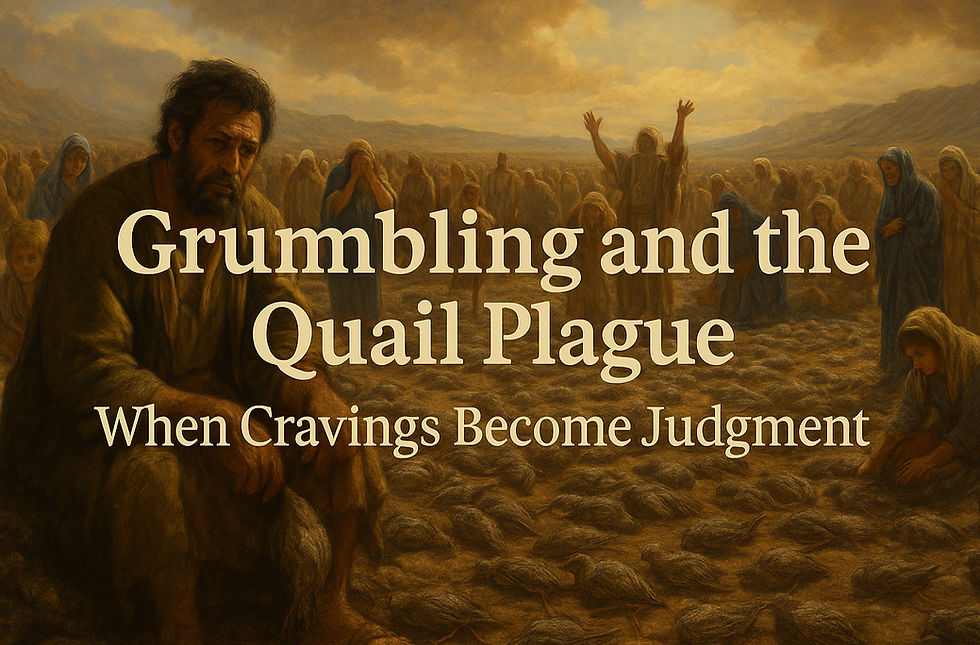
Grumbling and the Quail Plague: When Cravings Become Judgment
It didn’t take long for the freshly organized, trumpet-ready nation of Israel to lose its tune. Numbers 11 tells how complaints about hardship escalated into outright craving for Egypt’s menu. God responded with both provision and punishment. Their stomachs became their downfall—a timeless warning for anyone tempted to let appetites outrun gratitude.
Biblical Foundation
“Now the people became like those who complain of adversity in the ears of the LORD; and when the LORD heard it, His anger was kindled, and the fire of the LORD burned among them and consumed some of the outskirts of the camp… The rabble who were among them had greedy cravings; and the sons of Israel also wept again and said, ‘Who will give us meat to eat? We remember the fish which we ate freely in Egypt, the cucumbers, the melons, the leeks, the onions, and the garlic; but now our appetite is gone. There is nothing at all to look at except this manna.’” (Numbers 11:1, 4–6 NASB)
God sent quail in overwhelming abundance:
“You shall eat, not one day, nor two days, nor five days, nor ten days, nor twenty days, but for a whole month, until it comes out of your nostrils and it becomes loathsome to you; because you have rejected the LORD who is among you and have wept before Him, saying, ‘Why did we ever leave Egypt?’” (Numbers 11:19–20 NASB)
While the meat was still between their teeth, “the anger of the LORD was kindled against the people, and the LORD struck the people with a very severe plague.” (Numbers 11:33 NASB)
Additional Biblical Background: The First Appearance of Manna and Quail
Numbers 11 is not the first time Israel tasted either manna or quail. Soon after the Red Sea crossing, when their food ran out in the wilderness of Sin, God introduced both.
“In the evening the quail came up and covered the camp, and in the morning there was a layer of dew around the camp. When the layer of dew evaporated, behold, on the surface of the wilderness there was a fine flake-like thing, fine as the frost on the ground. When the sons of Israel saw it, they said to one another, ‘What is it?’ For they did not know what it was. And Moses said to them, ‘It is the bread which the LORD has given you to eat.’” (Exodus 16:13-15 NASB)
Key parallels and contrasts:
Grace before grumbling. The first quail and manna came as a gracious response to hunger and complaint (Exodus 16:2-4). God gave food and Sabbath rest without plague.
Daily dependence. Manna was to be gathered daily, teaching trust: “so that I may test them, whether or not they will walk in My instruction” (Exodus 16:4).
Foreshadowing Christ. Jesus pointed back to this first manna when He said, “It is not Moses who has given you the bread out of heaven, but it is My Father who gives you the true bread out of heaven” (John 6:32).
By recalling this Exodus beginning, Numbers 11 becomes sharper. Israel had a long history of miraculous feeding. Their later demands for variety were not innocent first-time doubts but a deeper rejection of God’s faithful provision.
Historical & Contextual Notes
Provision turned to contempt. Manna, literally “What is it?” (מָן), was heaven’s bread, but Israel called it monotonous. Craving variety revealed a deeper ingratitude.
Kibroth-hattaavah—Graves of Craving. The place where they buried the victims of the plague (Numbers 11:34) forever memorialized the danger of unchecked desire.
Quail migration. Huge flocks of migrating quail still cross the Sinai in spring, making the miracle historically plausible while highlighting God’s sovereignty over natural events.
Misconceptions / Objections
“God overreacted to hunger.”
Hunger wasn’t the issue—ingratitude and rebellion were. They despised the very God who fed them.
“Quail was a blessing, not judgment.”
It was both. God met their request but in a way that exposed their heart and ended in plague.
“Craving is harmless.”
Scripture repeatedly warns that unchecked desire leads to ruin (James 1:14–15; Philippians 3:19).
Theological Reflection
The Hebrew word for “craving” is אַוָּה (avvah), meaning intense desire or lust. Israel’s problem wasn’t food but worship—treating appetite as a god. Paul echoes this in “their god is their stomach” (Philippians 3:19).
Connection to Christ
True Bread from Heaven: Jesus says, “I am the bread of life; the one who comes to Me will not be hungry.” (John 6:35)
Warning for the Church: Paul cites this very incident: “Do not be idolaters, as some of them were… Nor let us act immorally… Nor grumble, as some of them did, and were destroyed by the destroyer.” (1 Corinthians 10:7–10)
Contentment in Christ: Philippians 4:11–13 shows that Christ strengthens us to find satisfaction beyond material cravings.
Christ-Centered Conclusion
Grumbling and craving can still bury people in “graves of desire.” God calls His people to trust His daily bread, not demand Egypt’s buffet. In Jesus—the true Bread and final Provider—our hearts can be full even in a wilderness.
All Scripture quotations are from the New American Standard Bible (NASB), © The Lockman Foundation. Used by permission. All rights reserved.


